
Home → Insights → Resting Heart Rate Chart
Resting Heart Rate Chart
Resting heart rate measures how many times the heart beats per minute while the body is at rest. It is one of the simplest indicators of cardiovascular health and overall fitness.
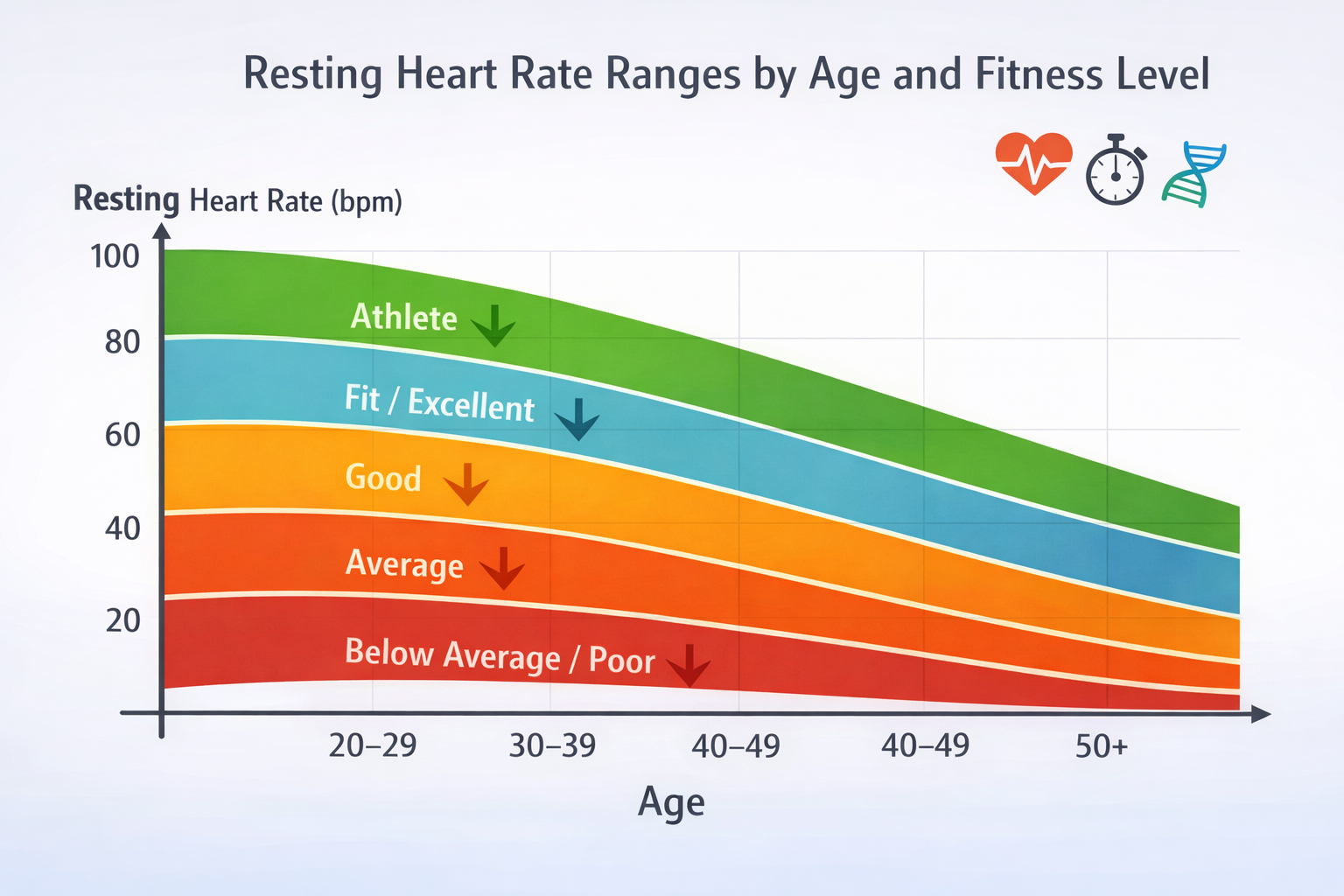
Normal Resting Heart Rate
For most adults, a normal resting heart rate falls between 60 and 100 beats per minute. Highly trained individuals often have significantly lower values.
Learn more about resting heart rate and its connection to heart rate variability (HRV).
Resting Heart Rate by Fitness Level
| Fitness Level | Resting Heart Rate |
|---|---|
| Athlete | 40 – 55 bpm |
| Excellent | 55 – 60 bpm |
| Good | 60 – 70 bpm |
| Average | 70 – 80 bpm |
| Below Average | 80 – 90 bpm |
| Poor | 90 – 100 bpm |
Athletes often show lower resting heart rates because their hearts pump blood more efficiently.
Resting Heart Rate by Age
Resting heart rate also varies slightly with age. Younger adults tend to have slightly lower values than older individuals.
See the full explanation in resting heart rate by age.
What Influences Resting Heart Rate?
- cardiovascular fitness
- stress levels
- sleep quality
- illness
- hydration
- caffeine or alcohol
A low resting heart rate combined with high HRV is often associated with strong cardiovascular health.
How to Improve Resting Heart Rate
- regular aerobic exercise
- better sleep
- stress management
- balanced nutrition
- limiting alcohol
These habits also improve sleep recovery.
FAQ
Is a resting heart rate of 50 good?
Yes. A resting heart rate around 50 bpm is common among well-trained athletes and usually indicates efficient cardiovascular function.
Is 80 bpm a bad resting heart rate?
80 bpm is still within the normal range but may indicate lower cardiovascular fitness compared to lower resting heart rates.
When should resting heart rate be checked by a doctor?
If resting heart rate consistently exceeds 100 bpm or falls below 40 bpm without athletic training, medical evaluation may be recommended.